rocketbat wrote:i suppose that because Eric's calculator gives information on the frequency i could get arround the pulsting thrust problems with some strong damping, the strength required coming from treating it as SHM?
If I read you right, you're worrying about the pulsation affecting the thrust you'll see? If so, don't.
rocketbat wrote:i have just been doing some calculations for drag (i have ignored weel friction for now) but do not know the referance area from the frontal view of a bike, pulsejet and rider so i subbed in 65lbs of thrust gives a speed of 75mph from Robert Maddox's efforts, this gave me a referance area of 0.48m^2
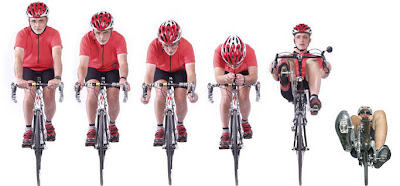
Sounds about right for a normal bike & rider in an "upright" position, yeah. Frontal area will vary depending on bicycle and rider position, though - how low can you go?
rocketbat wrote:the equation im using is F=(1/2)P(v^2)AC and im taking f as the resultant force so if i equal it with thrust in the opposite direction (F=0) then v^2 will be my terminal horizontal velocity (on a frictionless surface)
That looks correct, yes, although it's been a while since I've done drag calcs. Make sure you're doing all your calculations in the right units, of course.
If you graph Rayleigh's equation above, you'll notice that it's driven by the v^2 element; assuming you're going for something more than about 1m/s you can quite happily ignore rolling resistance unless you have a bike with flat tyres and all its bearings welded solid. You may need to give a little push with the pedals to get going, but that's a small price to pay.
Personally, I'd tend to optimise the thrust for the following:
1 - How safe I'd feel on a top-heavy bicycle carrying a quantity of fuel in proximity to a piece of red-hot metal at a given speed[1]
2 - How much fuel and weight I'd want to be carrying on a bicycle (less power == less fuel and less weight)
I would suggest that 10mph, maybe 20 at a push, on the flat, would be more than adequate[2]
Aiming for 20mph reduces your thrust requirements massively, which is going to make your life an awful lot easier. Less fuel, less worry about mounting brackets being able to handle the power and vibration, less worry about your engine collapsing (a big worry with bigger engines), marginally less hot metal hanging off your bike, etc.
Simon
[1] And this, bearing in mind that I'm happy riding motorcycles at *very* high speed.
[2] 20mph is about as fast as most people ride bikes over a decent distance anyway. Sure, people might expect you to make a jet-powered bike that goes really frickin' fast, but making a jet powered bike is enough of a claim to fame, even if it's barely capable of propelling itself. After all, do *they* have a jet powered bicycle? Nope, didn't think so.


 thats quite a shame, i really enjoyed reading through the forum.

